
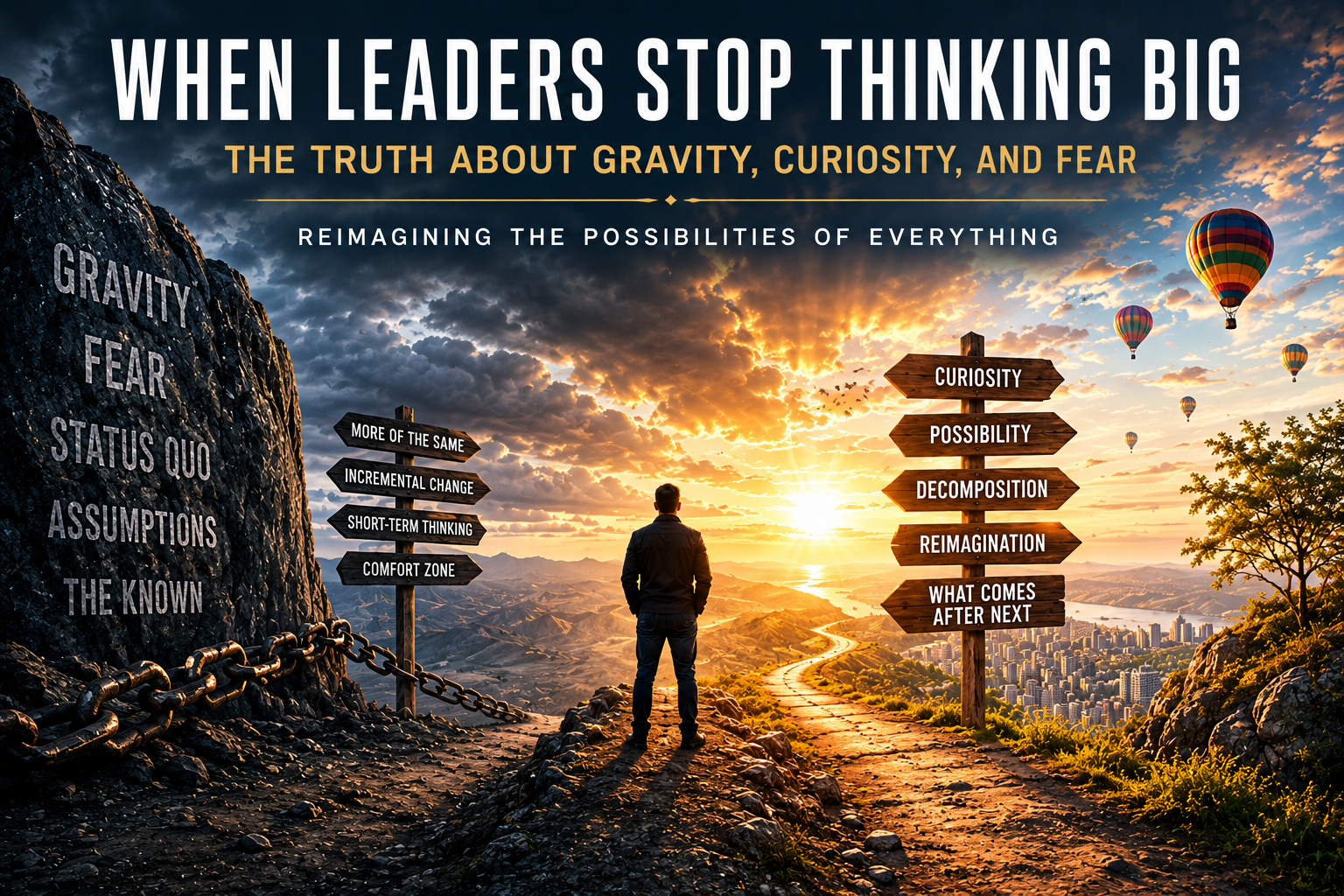
When Leaders Stop Thinking Big
The Truth About Gravity, Curiosity, and Fear
By Dr. Wesley Payne McClendon
McClendon Research Group / MRG, Inc.
Squeezing Leadership
Leaders rarely stop thinking big all at once. The narrowing of imagination is usually gradual, subtle, and socially reinforced. Most organizations do not intentionally discourage expansive thinking. In fact, they often celebrate innovation, transformation, and visionary leadership in theory. Yet beneath the language of ambition, leadership systems frequently reward predictability, operational certainty, measurable progress, and incremental success more consistently than exploratory or discontinuous thinking.
Over time, leaders learn which kinds of ideas are safe. Annual objectives, quarterly targets, incentive structures, performance scorecards, and promotion criteria communicate powerful signals about what matters most. Leaders are rewarded for delivering visible, defensible, measurable outcomes within defined time horizons. The result is not necessarily the elimination of creativity. It is the conditioning of leadership toward forms of thinking that remain close to the known, the measurable, and the politically familiar.
In many organizations, performance management systems quietly shape the boundaries of imagination and squeeze the innovative possibilities of leadership itself. Leaders learn to produce outcomes that can be counted, forecasted, benchmarked, and evaluated against existing assumptions. Measurement, accountability, and discipline are essential to organizational performance. The challenge emerges when measurement systems become overly attached to short-term predictability and linear progression at the expense of broader possibility.
Many Key Performance Indicator systems are linear and equidistant by design. They measure progress in predictable intervals: five percent growth, ten percent reduction, year-over-year improvement, or incremental efficiency gains against an established baseline. These measures create the appearance of strategic discipline, but they also reinforce a particular way of thinking. Leaders become conditioned to pursue the next expected level of performance rather than stretching the performance curve or questioning whether an entirely different curve should exist at all.
Equidistant performance systems reward predictable movement. They encourage leaders to climb the next rung of the ladder rather than question whether the ladder itself still leads to the future. Graduated measures, by contrast, encourage stretch, experimentation, asymmetrical progress, and movement beyond inherited assumptions. Yet in many environments, the risks associated with ambitious leaps often appear less rational than the safety of incremental gains.
This is how gravity quietly enters leadership cultures. Not through direct opposition to imagination, but through the repeated reinforcement of what feels measurable, defensible, and safe. Over time, optimization begins to replace exploration. Certainty becomes more valuable than curiosity. Leaders become increasingly skilled at improving the current structure while gradually losing their comfort with imagining forms that do not yet fully exist.
Eventually, these adaptations are passed on. Leaders teach their teams, often unintentionally, how to survive inside the same gravitational field: which ideas are safe to raise, which ambitions should be moderated, which risks are not worth taking, and which forms of curiosity should be contained. What begins as individual adaptation becomes cultural inheritance.
Leaders stop thinking big when fear becomes more influential than curiosity. The shift is rarely dramatic. It occurs through thousands of small organizational signals that reward preservation over possibility, continuity over emergence, and short-term certainty over the discomfort that often accompanies transformational thinking.
Living with Gravity
Gravity is not a policy. It is an experience. Most leaders have felt it: the hesitation before proposing an unconventional idea, the instinct to soften a bold recommendation, the pressure to translate possibility into something more acceptable, measurable, or familiar. Gravity is the force that pulls imagination back toward the known and comfortable.
In organizations, gravity operates through habits, assumptions, incentives, identities, expertise, and expectations. It does not necessarily prevent movement. Leaders remain free to imagine, question, and explore. What gravity does is make movement away from the familiar feel heavier. It rewards alignment with existing assumptions while increasing the effort required to pursue ideas that challenge them.
The most influential forms of gravity are often the least visible. They become embedded in language, routines, reporting structures, budgeting cycles, governance processes, and long-established definitions of success. What may have started as useful organizational discipline gradually becomes an assumption about how leadership should think and what leadership should value.
As organizations mature, stability often becomes psychologically intertwined with competence. Leaders are promoted because they understand the current system, know how to operate within existing structures, and can reliably deliver predictable outcomes. Expertise becomes attached to preservation of the known. The same expertise that allows leaders to optimize the current form can also make it more difficult to question the assumptions that sustain it.
In many environments, leaders are not only managing performance. They are managing legitimacy. Ideas that align with established expectations are often viewed as disciplined, strategic, and credible, while ideas that challenge existing assumptions may be perceived as impractical, premature, or unnecessarily risky. As a result, leaders gradually learn to calibrate their thinking toward what can be defended rather than what might become possible.
Gravity also operates socially. Leaders observe which ideas receive support, which ambitions are rewarded, and which forms of experimentation quietly disappear. Over time, organizations create unwritten rules about how much curiosity is acceptable before it begins to threaten comfort, hierarchy, predictability, or identity. These rules are rarely documented, but they are often deeply understood.
The result is not the disappearance of innovation, but the narrowing of imaginative range. Organizations continue improving, optimizing, refining, and modernizing existing systems while becoming increasingly uncomfortable with ideas that require movement beyond the logic of the current form. Incremental progress preserves continuity. Discontinuous possibility creates tension because it asks leaders to imagine futures that cannot yet be fully measured, validated, or controlled.
This is one of the quiet paradoxes of leadership: the very structures designed to create alignment, stability, and performance can gradually reduce the distance leaders feel permitted to travel beyond the known. Gravity does not eliminate imagination. It simply pulls imagination back toward what already exists.
Curiosity and the Possibilities of Everything
If gravity pulls leaders toward the known, curiosity pulls them toward possibility. It is one of the most underappreciated leadership capabilities in modern organizations. We often celebrate curiosity in children, entrepreneurs, scientists, and inventors, yet rarely discuss it as a core leadership competency. Instead, we tend to reward expertise, decisiveness, confidence, and execution. All are important. But none expands the boundaries of possibility in quite the same way as curiosity.
Curiosity is often misunderstood as a search for answers. In reality, its greatest value lies in the questions it creates. Curious leaders ask different questions than purely operational leaders. They are less concerned with how to optimize the current system and more interested in understanding what assumptions created the system in the first place. They ask not only, 'How do we do this better?' but also, 'What if we are solving the wrong problem?', 'What if we are asking the wrong question?' and 'What becomes possible if we stop assuming today's constraints will exist tomorrow?'
Throughout history, transformational breakthroughs rarely began with certainty. More often, they began with curiosity. The airplane emerged because someone became curious about human flight. The internet emerged because people became curious about connecting information across vast distances. Wireless technologies emerged because engineers and scientists became curious about whether physical connections were always necessary. Before every significant advance sits a question that challenged an accepted assumption.
The difficulty is that curiosity often appears inefficient. It lacks a clearly defined destination and rarely follows a predictable path. It explores before it concludes. It questions before it decides. It entertains possibilities before evidence is fully available. In environments driven by deadlines, performance targets, and operational pressures, curiosity can feel indulgent, impractical, or even disruptive. Yet possible futures are rarely discovered through the efficient execution of yesterday's assumptions.
Curious leaders possess a unique relationship with uncertainty. They do not necessarily enjoy ambiguity more than anyone else, nor are they immune to risk. What distinguishes them is their willingness to remain in the presence of uncertainty long enough to learn and apply something new. While others rush toward closure, curious leaders remain open to the unknown. They resist the temptation to convert every unknown into a familiar answer.
Curiosity also creates cognitive range and depth. It expands the number of possibilities leaders are willing to consider before settling on a decision. Leaders who lose curiosity often narrow their options prematurely. They become highly effective at selecting among existing alternatives while becoming less capable of imagining alternatives that do not yet exist. The result is not poor decision-making. It is a shrinking field of possibility from which decisions are made.
This is why curiosity matters so much in periods of transformation. When industries shift, technologies emerge, customer expectations change, or institutions confront disruption, the future rarely arrives in a form that neatly fits existing assumptions. Curiosity allows leaders to explore what is emerging before it becomes obvious. It creates the mental, organizational, and leadership space necessary for new possibilities to take shape and thrive.
The irony is that curiosity becomes most important precisely when gravity becomes strongest. The more successful a system becomes, the greater the temptation to rely on existing knowledge, proven models, and familiar answers. Yet it is often during these periods of success that leaders most need the courage to remain curious. Yesterday's answers may explain how an organization arrived where it is today. Curiosity helps leaders discover where it might go next.
Years ago, a CEO shared an observation that has stayed with me ever since. He argued that sustainable innovation rarely begins at the bottom of the organization. It begins with curiosity at the top. Organizations innovate when leaders create permission for new questions, new possibilities, and new ways of thinking. Curiosity legitimizes exploration. Exploration creates discovery. Discovery creates innovation. In that sense, innovation is often not the cause of transformation. It is the consequence of curiosity.
Curiosity does not eliminate gravity. It creates the lift necessary to see beyond it. It allows leaders to look beyond the horizon of current assumptions and imagine possibilities that cannot yet be measured, predicted, or fully understood. Before every transformation, before every breakthrough, and before every meaningful act of leadership, there is usually a moment of curiosity that asks a simple but powerful question:
What if there is another way?
When Fear Overrules Curiosity
Fear rarely announces itself as fear in leadership settings. It usually arrives dressed as prudence, discipline, caution, risk management, fiduciary responsibility, or strategic realism. Each has a legitimate place in leadership. Organizations need discipline. They need risk awareness. They need leaders who can distinguish imagination from fantasy. But fear becomes dangerous when it begins to overrule curiosity before curiosity has been allowed to do its work.
When fear overrules curiosity, leaders begin closing questions too early. They move too quickly from possibility to practicality, from imagination to justification, from exploration to defensibility. The question shifts from 'What might be possible?' to 'How would we explain this if it does not work?' That shift may appear responsible, but it often narrows the field of thought before the organization has truly explored what could emerge.
Fear is powerful because it attaches itself to real concerns. Leaders fear wasting resources. They fear reputational damage. They fear political exposure. They fear losing credibility. They fear unsettling the people and systems they are responsible for leading. These fears are not irrational. They are often grounded in experience. The problem is not that leaders feel fear. The problem is when fear becomes the dominant interpreter of possibility.
Once fear becomes the interpreter, curiosity starts to sound naive. Ambition sounds reckless. Imagination sounds undisciplined. Questions that once opened possibility begin to feel like threats to stability. This is how organizations gradually convert uncertainty into danger and possibility into risk.
The deeper issue is that fear does not only protect organizations from bad decisions. It can also protect them from becoming different. It keeps leaders attached to systems they understand, capabilities they trust, and identities that have produced success in the past. Fear can make the current form feel safer simply because it is familiar, even when that form is becoming less suited to the future.
This is why fear and gravity work so well together. Gravity pulls leaders toward the known. Fear gives them a reason to stay there. Together, they make preservation feel rational and exploration feel irresponsible. The organization may still talk about innovation, transformation, and reinvention, but its deeper emotional logic remains organized around protection.
The danger is not that fear eliminates thinking. It often produces a great deal of thinking: analysis, reviews, forecasts, scenarios, risk registers, governance papers, and committee discussions. But much of this thinking is designed to contain uncertainty rather than learn from it. Fear does not stop the organization from thinking. It changes the purpose of thinking.
When fear overrules curiosity, leaders become highly skilled at explaining why the future should remain close to the present. They can justify incremental movement. They can defend caution. They can describe why the timing is not right, why the evidence is incomplete, why the organization is not ready, and why the safer path is more responsible. Sometimes they are right. But sometimes the safer path is simply the familiar path wearing the language of discipline.
This does not mean leaders should ignore fear. Fear carries information. It points to vulnerabilities, dependencies, exposures, and consequences that curiosity alone may miss. The goal is not to eliminate fear. The goal is to prevent fear from becoming the final authority over what the organization is allowed to imagine.
Big thinking requires a different relationship with fear. It asks leaders to listen to fear without surrendering to it. It asks them to examine risk without allowing risk to define the outer boundary of possibility. It asks them to hold curiosity and caution in productive tension long enough for new thinking to mature.
Leaders stop thinking big when fear becomes more influential than curiosity. But they begin thinking big again when they recognize fear not as the enemy of leadership, but as a signal that something important may be at stake. The question is whether fear will close the conversation or deepen it.
Implications for Leaders
The practical challenge for leaders is not to choose curiosity over discipline or imagination over performance. The challenge is to prevent discipline from becoming a substitute for imagination. Organizations still need measurement, governance, accountability, and risk management. But these systems should help leaders test possibility, not merely defend the existing form.
Leaders who want to think big again must ask where gravity has entered the system. Which ideas are treated as safe? Which assumptions are no longer questioned? Which risks are discussed repeatedly, and which possibilities are rarely allowed to mature? These questions do not weaken leadership discipline. They restore it by reconnecting performance to purpose, courage, and discovery.
Transformation begins when leaders create permission for better questions. Curiosity expands the field of possibility. Fear clarifies what is at stake. Discipline turns possibility into responsible action. The work of leadership is to hold all three in tension without allowing any one of them to dominate the future.
About the Author
Dr. Wesley Payne McClendon is an executive, advisor and researcher whose work focuses on leadership, transformation, workforce strategy, and organizational capability. He is the founder of McClendon Research Group / MRG, Inc., where he develops practical research, advisory frameworks, and executive insights to help leaders build the capability to lead transformation under pressure.